How to Trade Meme Coins Without Losing Your Deposit to Emotions and Rugs
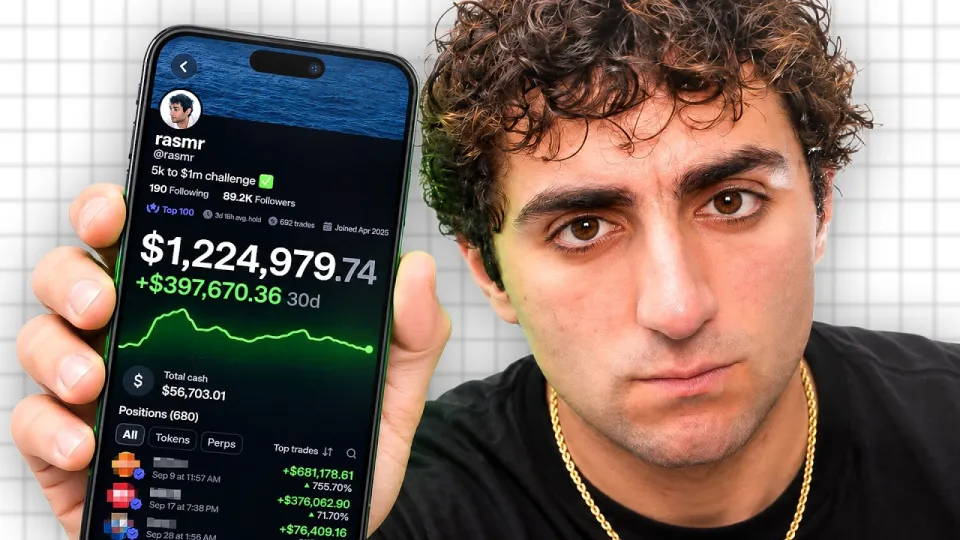
Video: 5 Years of Memecoin Knowledge in 12 Minutes
You can order the same kind of articles for your own video to boost it on YouTube and Google. Just message the Telegram bot @sat_sit_bot. The bot writes and publishes the articles itself (with your YouTube video embedded) on popular topical websites (no ads). Try it free: 50 articles on us.
· based on the channel rasmr
Key takeaways
- Meme coin prices are driven by narrative and liquidity, not by fundamentals — the token's story and who launched it matter more than the chart.
- Most exits happen in predictable market cap bands, so a pre-planned sell ladder beats holding for a round trip.
- Emotions are the main account killer: averaging into a losing position and top-blasting after a green candle are the two most common failures.
- Insider circles around launches get the announcement before the public, which is why early entries look impossible to outsiders.
- Position sizing and a written exit plan must be set before the buy, not after the price starts moving.
Meme coin trading is a game of narrative, liquidity and exit discipline, not of charts and fundamentals. The workable approach is to buy a story early, size the position so a full loss is survivable, and sell in planned tranches at market cap levels where the crowd historically takes profit. Everything else — indicators, alerts, group chats — is secondary to those three decisions, and a trading account opened through fomo.family registration is only as good as the plan behind it.
What actually moves a meme coin price
A meme coin has no cash flow, so its price is set by attention and by how much liquidity sits on the order book at any moment. That means three inputs matter: the narrative (why people are talking about this token right now), the launch quality (who released it, how the supply is distributed, whether insiders hold a large share), and the depth of liquidity that lets price travel up or down fast. A token with a funny ticker and no distribution data is a lottery ticket; a token with a fresh narrative, a documented launch and visible holders is a trade.
Practically, before any buy, check:
- Who launched the token and what wallet history sits behind it.
- How much of the supply is held by the top wallets and whether those wallets are linked.
- Whether the narrative is new or a copy of something that already peaked.
- What the current market cap is relative to the ceiling the narrative can realistically reach.
- Whether liquidity is enough to exit your size without moving the price against you.
Why emotions cost more than bad picks
The most expensive mistakes in meme coin trading are behavioural, not analytical: traders cut winners early out of fear and hold losers out of hope. The classic pattern is buying after a green candle, expecting continuation, then watching the position round-trip from a healthy profit back to break-even or a loss. The mirror pattern is refusing to take a loss because the chart "has to bounce", and averaging down into a token whose narrative has already died. Both come from the same root — the exit was never defined before entry.
A workable rule set looks like this: decide the invalidation point and the first profit target before the buy order; write them down; treat the plan as fixed for the duration of the trade. If the position doubles and the plan says sell a third, sell a third. If the thesis breaks, exit even at a loss, because a dead narrative rarely recovers its old market cap.
How to build a sell ladder around market cap
Meme coins tend to stall at repeating market cap bands, because that is where earlier buyers and insiders start distributing. Instead of guessing a top on the chart, map the token's market cap against the bands where similar narratives historically lost momentum, and place exits below those levels. A simple ladder: sell a portion at the first psychological milestone, another portion after a large multiple, and keep a small runner only with money you have already mentally written off.
The reason this matters is arithmetic. Going from a small cap to a mid cap is a large percentage move; going from that mid cap to a billion-dollar valuation is a far bigger ask and requires a narrative that can carry the whole market's attention. Traders who hold for the second leg usually give back the first one.
Reading the launch circle and the insider advantage
Early entries in meme coins often come from private groups where a launch is announced before the public sees it, which is why some wallets are always first. That structure is not a conspiracy theory — it is simply how coordinated launches work — but it does mean retail traders are usually buying from people who know more. The practical response is not to chase the first minutes of every launch but to accept a later, better-documented entry with a smaller edge and a clearer exit.
Signals that a launch is being distributed to insiders rather than to the market include a supply concentration in fresh wallets, social channels that appear fully formed before the token does, and price action that spikes on tiny volume and then flattens. If you cannot identify who is selling to you, size down or skip the trade.
Common questions traders ask before their first trade
Newer traders tend to ask the same few things, and the answers are mostly about process rather than prediction. Can a small account trade meme coins? Yes — small size is an advantage, because it lets you take a full loss without damaging your capital and practice exits without slippage. Should you copy insider wallets? Only as one input; a wallet's past wins do not guarantee the next launch, and you rarely see the exit in time. What about themed tokens tied to games or events? A strong theme can create attention, but attention without a launch plan and liquidity is not a trade. And how do you avoid rugs? Check holder concentration, check whether liquidity is locked or removable, and assume any token without those answers is a rug until proven otherwise.
Useful links
Final takeaways
Meme coin trading rewards preparation far more than prediction: know the narrative, know who launched the token, size the position so a total loss is acceptable, and set exits at market cap levels rather than at feelings. The most repeated failure among traders is not picking a bad coin — it is holding a large unrealised profit until it disappears, or refusing to accept a small loss until it becomes a large one. Treat every trade as a plan with a defined end, and treat the market cap chart as the map of where other people will sell. The breakdown behind these rules comes from the rasmr channel, whose twelve-minute summary of five years of meme coin experience is worth watching alongside this guide. If you want to put the plan into practice, start with a fomo.family account and keep the first positions small.
Source: 5 Years of Memecoin Knowledge in 12 Minutes · Markdown version
Questions & answers
How much of my portfolio should go into a single meme coin?
Only an amount you can lose entirely without changing your financial situation — for most traders that is a small single-digit percentage of trading capital per position. Small size lets you take a full loss without emotion and exit without slippage. Increase size only after you have a repeatable process and a track record of following your own exit plan.
Why do meme coins often crash right after a big run?
Because the people who bought earliest, including launch insiders and private groups, start distributing at market cap levels where their position becomes life-changing. Price stalls when supply from those wallets meets new buyers. Mapping those market cap bands in advance is more useful than trying to read the chart in real time.
Can I trade meme coins with a very small account?
Yes, and a small account is actually a better place to learn, because mistakes cost little and you can practise entries, exits and position sizing. Focus on one or two narratives at a time, keep a written plan for every trade, and do not add leverage to compensate for small size.
How do I spot a token that is likely to rug?
Look for a large share of supply in a few fresh wallets, liquidity that can be pulled by the deployer, and social channels that existed before the token did. If you cannot identify who launched it or who is selling to you, skip the trade. Any token without transparent holder and liquidity data should be treated as a rug until proven otherwise.